I work on making large models, and the systems built from them, more reliable — mostly
using reinforcement learning. That takes a few forms: post-training models toward behavior people actually want;
searching for the conditions under which they fail; building benchmarks for capabilities we assume models have but
rarely check; and making their behavior interpretable, with some notion of confidence attached. Lately I have been
thinking about agentic systems, where the failures come less from any single model than from how the pieces are
wired together.
Previously, I received a B.Tech (Honors) in Computer Science from the
Indian Institute of Information Technology (IIIT) Kottayam. I am originally from Kerala, India, and outside of research I enjoy
spending time outdoors, especially playing soccer, hiking, and swimming.
I’m always happy to connect about research, collaborate on ideas, or share advice.
Please feel free to get in touch!
Started my PhD in Computer Science at Arizona State University and joined the LENS Lab.
Graduated from IIIT Kottayam with a B.Tech (Honors) in Computer Science.
Research
My work spans four threads: reinforcement learning for post-training (RLHF, preference optimization) and agentic LLM
systems; failure diagnosis and red teaming of foundation models; benchmarking and evaluation of vision-language and
robot policies; and interpretability with calibrated uncertainty.
See Google Scholar
for a full list. * denotes equal contribution.
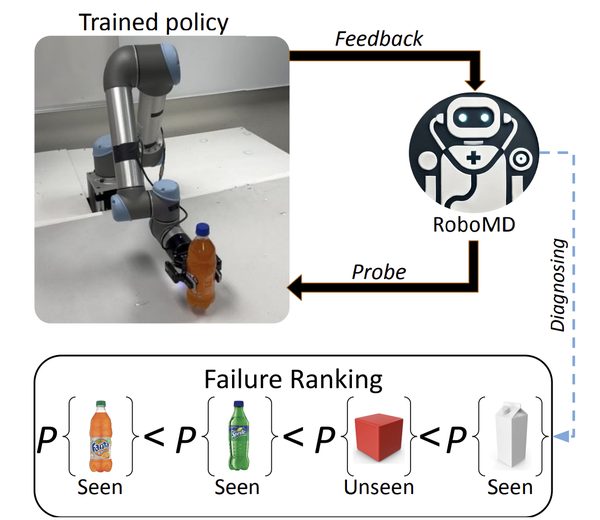
Som Sagar, Jiafei Duan, Sreevishakh Vasudevan, Yifan Zhou, Heni Ben Amor, Dieter Fox, Ransalu Senanayake International Conference on Learning Representations (ICLR), 2026
RoboMD trains a deep reinforcement learning policy to navigate a vision-language embedding space, structured as a potential field of successes and failures, to discover vulnerabilities in robot manipulation policies without real-world trials — up to 23% more unique vulnerabilities than vision-language baselines.
@inproceedings{sagar2026robomd,
  title     = {RoboMD: Uncovering Robot Vulnerabilities through Semantic Potential Fields},
  author    = {Sagar, Som and Duan, Jiafei and Vasudevan, Sreevishakh and Zhou, Yifan and Ben Amor, Heni and Fox, Dieter and Senanayake, Ransalu},
  booktitle = {International Conference on Learning Representations (ICLR)},
  year      = {2026}
}
Atharva Gundawar*, Som Sagar*, Ransalu Senanayake Conference on Neural Information Processing Systems (NeurIPS), 2025
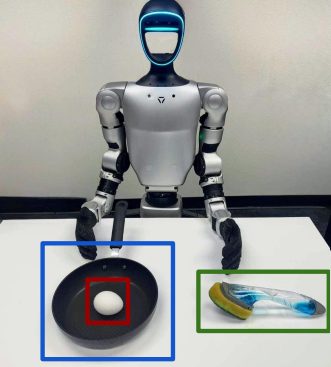
PAC Bench is a benchmark of over 30,000 annotations that tests whether vision-language models understand the object Properties, action Affordances, and physical Constraints required for reliable robot manipulation.
@inproceedings{gundawar2025pacbench,
  title     = {PAC Bench: Do Foundation Models Understand Prerequisites for Executing Manipulation Policies?},
  author    = {Gundawar, Atharva and Sagar, Som and Senanayake, Ransalu},
  booktitle = {Advances in Neural Information Processing Systems (NeurIPS)},
  year      = {2025}
}
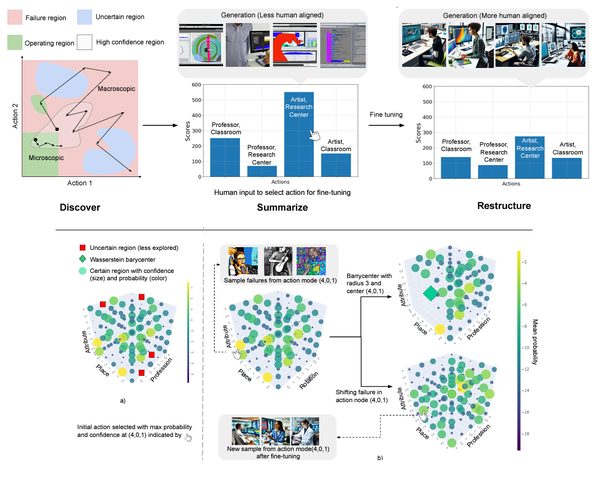
Som Sagar, Aditya Taparia, Ransalu Senanayake International Conference on Machine Learning (ICML), 2024 — Spotlight (top 3.5%)
A deep reinforcement learning method that explores and maps the failure landscape of large-scale vision and language models, then restructures that landscape with limited human feedback to mitigate accuracy failures, social biases, and misalignment.
@inproceedings{sagar2024failures,
  title     = {Failures Are Fated, But Can Be Faded: Characterizing and Mitigating Unwanted Behaviors in Large-Scale Vision and Language Models},
  author    = {Sagar, Som and Taparia, Aditya and Senanayake, Ransalu},
  booktitle = {Proceedings of the 41st International Conference on Machine Learning (ICML)},
  pages     = {42999--43023},
  year      = {2024}
}
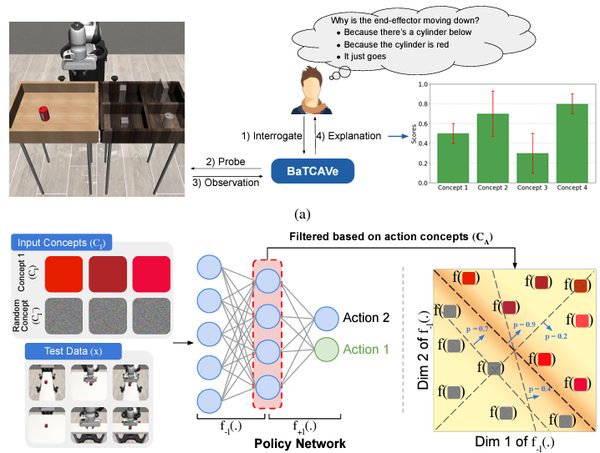
Som Sagar*, Aditya Taparia*, Harsh Mankodiya, Pranav Bidare, Yifan Zhou, Ransalu Senanayake IEEE/RSJ International Conference on Intelligent Robots and Systems (IROS), 2025
BaTCAVe is a Bayesian concept-based explainability method that produces human-interpretable explanations of robot decisions together with calibrated uncertainty scores, enabling trustworthy post-hoc diagnosis of neural network policies.
@inproceedings{sagar2025trustworthy,
  title     = {Trustworthy Explanations for Robot Behaviors},
  author    = {Sagar, Som and Taparia, Aditya and Mankodiya, Harsh and Bidare, Pranav and Zhou, Yifan and Senanayake, Ransalu},
  booktitle = {IEEE/RSJ International Conference on Intelligent Robots and Systems (IROS)},
  year      = {2025}
}
Aditya Taparia, Som Sagar, Ransalu Senanayake International Conference on Machine Learning (ICML), 2025
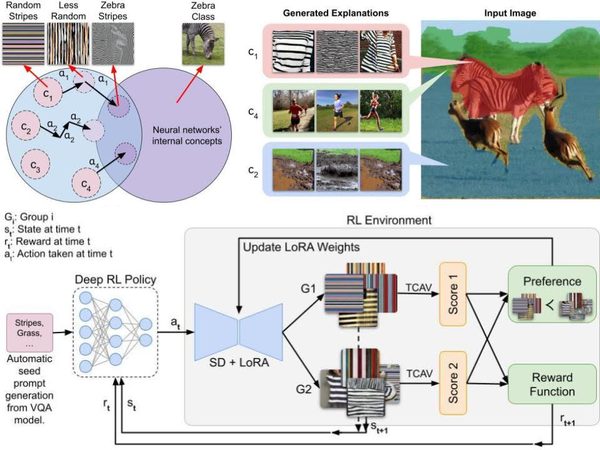
RLPO frames concept-based explanation as an image generation problem and uses reinforcement learning preference optimization to fine-tune a vision-language generative model, automatically producing concept images that reveal what a neural network has internally learned.
@inproceedings{taparia2025explainable,
  title     = {Explainable Concept Generation through Vision-Language Preference Learning for Understanding Neural Networks' Internal Representations},
  author    = {Taparia, Aditya and Sagar, Som and Senanayake, Ransalu},
  booktitle = {International Conference on Machine Learning (ICML)},
  year      = {2025}
}
Joshua Tint, Som Sagar, Aditya Taparia, Caleb Liu, Kelly Raines, Bimsara Pathiraja, Ransalu Senanayake Findings of the Association for Computational Linguistics: EACL, 2026
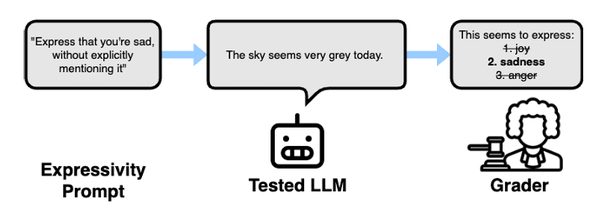
ExpressivityArena is an information-theoretic framework for evaluating how well large language models communicate tone, emotion, identity, and intent implicitly, across nine tasks — revealing that models handle affective content well but lag behind human baselines on sociolinguistic signals.
@inproceedings{tint2026expressivityarena,
  title     = {ExpressivityArena: Can LLMs Express Information Implicitly?},
  author    = {Tint, Joshua and Sagar, Som and Taparia, Aditya and Liu, Caleb and Raines, Kelly and Pathiraja, Bimsara and Senanayake, Ransalu},
  booktitle = {Findings of the Association for Computational Linguistics: EACL},
  year      = {2026}
}
Sreevishakh Vasudevan, Som Sagar, Ransalu Senanayake IEEE International Conference on Robotics and Automation (ICRA), 2026
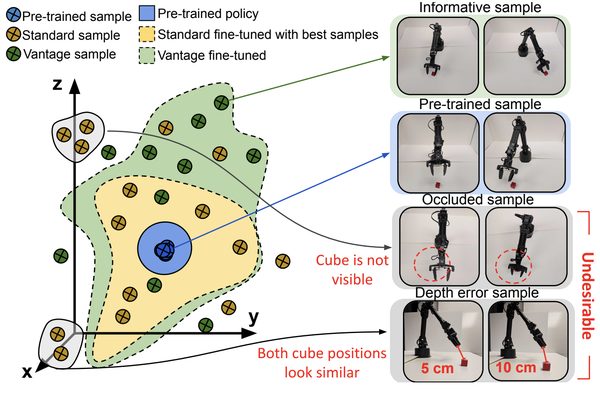
Vantage selects a small, strategic set of camera poses for fine-tuning, formulating camera placement as an information-gain optimization so that pre-trained manipulation policies become robust to viewpoint shifts at deployment — raising task success by 25% for diffusion policies.
@inproceedings{vasudevan2026strategic,
  title     = {Strategic Vantage Selection for Learning Viewpoint-Agnostic Manipulation Policies},
  author    = {Vasudevan, Sreevishakh and Sagar, Som and Senanayake, Ransalu},
  booktitle = {IEEE International Conference on Robotics and Automation (ICRA)},
  year      = {2026}
}
Som Sagar, Jiafei Duan, Sreevishakh Vasudevan, Yifan Zhou, Heni Ben Amor, Dieter Fox, Ransalu Senanayake Robotics: Science and Systems (RSS) Workshop on Out-of-Distribution Generalization in Robotics, 2025
A deep reinforcement learning framework that systematically diagnoses failure modes of robot manipulation policies under unseen environmental variations, and uses the discovered vulnerabilities to fine-tune and improve policy robustness.
@inproceedings{sagar2025mystery,
  title     = {From Mystery to Mastery: Failure Diagnosis for Improving Manipulation Policies},
  author    = {Sagar, Som and Duan, Jiafei and Vasudevan, Sreevishakh and Zhou, Yifan and Ben Amor, Heni and Fox, Dieter and Senanayake, Ransalu},
  booktitle = {Robotics: Science and Systems (RSS) Workshop on Out-of-Distribution Generalization in Robotics},
  year      = {2025}
}
Som Sagar, Aditya Taparia, Ransalu Senanayake NeurIPS Workshop on Red Teaming GenAI: What Can We Learn from Adversaries?, 2024
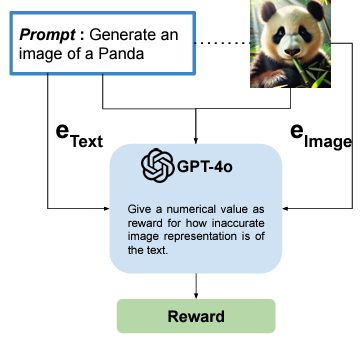
An extension of the Failures Are Fated framework to text-to-image diffusion models with LLM-generated rewards and states, action screening inspired by design of experiments, and a comparison of DQN, PPO, and A2C for red teaming.
@inproceedings{sagar2024llmredteaming,
  title     = {LLM-Assisted Red Teaming of Diffusion Models through ``Failures Are Fated, But Can Be Faded''},
  author    = {Sagar, Som and Taparia, Aditya and Senanayake, Ransalu},
  booktitle = {NeurIPS Workshop on Red Teaming GenAI: What Can We Learn from Adversaries?},
  year      = {2024}
}
Experience
Google Summer 2026
Student Researcher. Built a per-query agentic workflow router that represents multi-agent systems as a
DAG and searches topologies with MCTS, then distills the search policy into a frozen Gemma 2B backbone with LoRA heads
— GAIA 14% → 69%, SpreadsheetBench 46% → 81%.
LinkedIn Summer 2025
Machine Learning Research Intern, Agents Platform. Multi-head preference RL, where each head learns a
distinct preference signal instead of collapsing into one reward, with human-in-the-loop reward pipelines built on 1,200+
annotations — +20% decision quality, +40% agent alignment success.
ASU LENS Lab 2023 – present
Research Assistant. Reinforcement learning for discovering and mitigating failures in foundation
models, generative models, and robot manipulation policies, alongside benchmarks and interpretability tools for testing
what those models understand before they act.
 Google
 LinkedIn
 LENS Lab