Since most datasets can be modelled using a gaussian distribution. we can assume that clusters come from different gaussians.
A Gaussian mixture model (GMM) is a soft clustering technique used in unsupervised learning to determine the probability that a given data point belongs to a cluster.
A Gaussian mixture is a function that is composed of several Gaussians, each identified by k ∈ {1,…, K}, where K is the number of clusters of our data set. Each gaussian is defined using its mean which defines its center, a covariance which defines its width and a mixing probability which defines the size of the gaussian. The mixing coefficients are themselves probabilities and must meet this condition .
In one dimension the gaussian distribution the probability density function (PDF) is given by:

A multivariant gaussian distribution, the PDF is given as

Since there are K such clusters and the probability density is defined as a linear function of densities of all these K distributions, i.e.

For estimating the parameters we use maximum log-likelihood method and take its derivative nad compute to get.
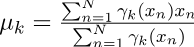

is a random variable such that .
Here is the total number of sample points in the kth cluster.
Expectation-Maximization
The expectation maximization(EM) algorithm is an iterative way to find maximum-likelihood estimates for model parameters when the data is incomplete or has some missing data points or has some hidden variables.
Estimation step
In the estimation step, we first initialize our model parameters like the mean, covariance matrix, and mixing coefficients.
For each data point, We calculate the posterior probabilities of data points belonging to each centroid using the current parameter values. These probabilities are represented by the .
At the end Estimate the values of the latent variables based on the current parameter values
Maximization step
In the maximization step, we update parameter values
We will update the mean of the cluster point by taking the weighted average of data points using the corresponding latent variable probabilities
We will update the covariance matrix by taking the weighted average of the squared differences between the data points and the mean, using the corresponding latent variable probabilities.
We will update the mixing coefficients by taking the average of the latent variable probabilities for each component.
class GMM(nn.Module):
    def __init__(self, n_components, n_features):
        super(GMM, self).__init__()
        self.n_components = n_components
        self.n_features = n_features

        self.pi = nn.Parameter(torch.ones(n_components) / n_components)
        self.mu = nn.Parameter(torch.randn(n_components, n_features))
        self.sigma = nn.Parameter(torch.eye(n_features).repeat(n_components, 1, 1))

    def forward(self, x):
        log_prob = []
        for k in range(self.n_components):
            dist = torch.distributions.MultivariateNormal(self.mu[k], self.sigma[k])
            log_prob.append(dist.log_prob(x) + torch.log(self.pi[k]))
        log_prob = torch.stack(log_prob, dim=1)
        return torch.logsumexp(log_prob, dim=1)

    def fit(self, x, n_iterations=1000):
        optimizer = torch.optim.Adam(self.parameters())
        for _ in range(n_iterations):
            optimizer.zero_grad()
            loss = -self.forward(x).mean()
            loss.backward()
            optimizer.step()