Strategic Vantage Selection for Learning Viewpoint-Agnostic Manipulation Policies
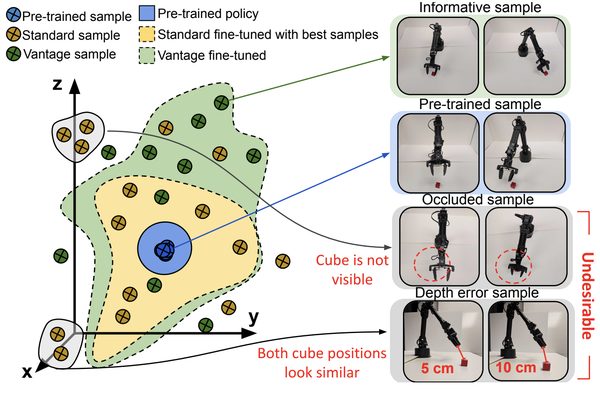
In one sentence. Vantage selects a small, strategic set of camera poses for fine-tuning, formulating camera placement as an information-gain optimization so that pre-trained manipulation policies become robust to viewpoint shifts at deployment — raising task success by 25% for diffusion policies.
Abstract
Since vision-based manipulation policies are typically trained from data gathered from a single viewpoint, their performance drops when the view changes during deployment. Naively aggregating demonstrations from numerous random views is not only costly but also known to destabilize learning, as excessive visual diversity acts as noise. We present Vantage, a viewpoint selection framework to fine-tune any pre-trained policy on a small, strategically set of camera poses to induce viewpoint-agnostic behavior. Instead of relying on costly brute-force search over viewpoints, Vantage formulates camera placement as an information gain optimization problem in a continuous space. This approach balances exploration of novel poses with exploitation of promising ones, while also providing theoretical guarantees about convergence and robustness. Across manipulation tasks and policy families, Vantage consistently improves success under viewpoint shifts compared to fixed, grid, or random data selection strategies with only a handful of fine-tuning steps. Experiments conducted on simulated and real-world setups show that Vantage increases the task success rate by 25% for diffusion policies, and yields robust gains in dynamic-camera settings.
BibTeX
@inproceedings{vasudevan2026strategic,
  title     = {Strategic Vantage Selection for Learning Viewpoint-Agnostic Manipulation Policies},
  author    = {Vasudevan, Sreevishakh and Sagar, Som and Senanayake, Ransalu},
  booktitle = {IEEE International Conference on Robotics and Automation (ICRA)},
  year      = {2026}
}
Topics
robot manipulation, viewpoint generalization, diffusion policy, distribution shift, robustness, information gain