Publications
Papers by Som Sagar on failure diagnosis, red teaming, and evaluation of foundation models, vision-language models, and robot manipulation policies. See also Google Scholar and the CV.
Conference papers
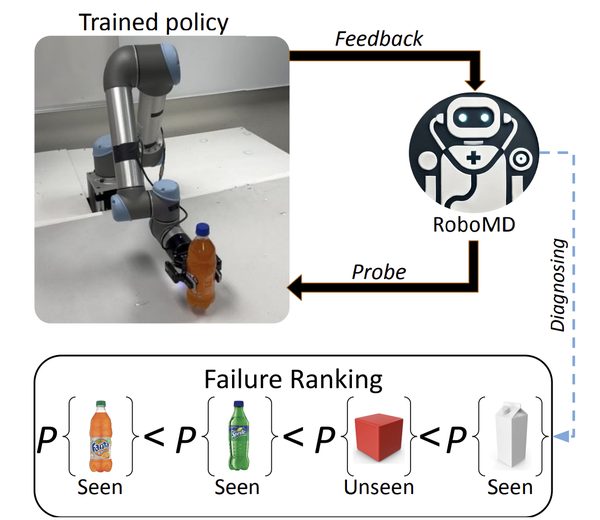 |
RoboMD: Uncovering Robot Vulnerabilities through Semantic Potential FieldsSom Sagar, Jiafei Duan, Sreevishakh Vasudevan, Yifan Zhou, Heni Ben Amor, Dieter Fox, Ransalu Senanayake International Conference on Learning Representations (ICLR), 2026 RoboMD trains a deep reinforcement learning policy to navigate a vision-language embedding space, structured as a potential field of successes and failures, to discover vulnerabilities in robot manipulation policies without real-world trials — up to 23% more unique vulnerabilities than vision-language baselines.
Details
arXiv
|
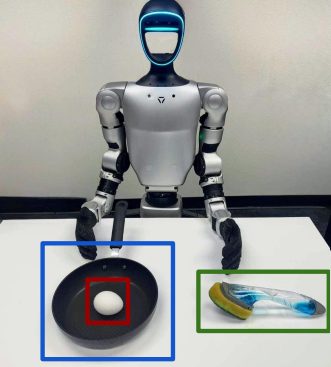 |
PAC Bench: Do Foundation Models Understand Prerequisites for Executing Manipulation Policies?Atharva Gundawar*, Som Sagar*, Ransalu Senanayake Conference on Neural Information Processing Systems (NeurIPS), 2025 PAC Bench is a benchmark of over 30,000 annotations that tests whether vision-language models understand the object Properties, action Affordances, and physical Constraints required for reliable robot manipulation.
Details
arXiv
|
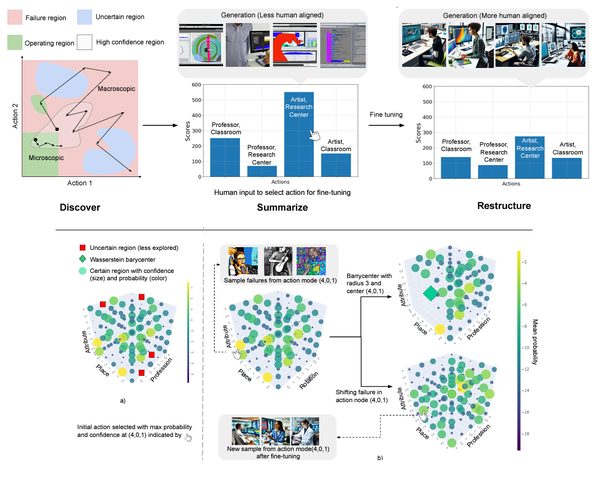 |
Failures Are Fated, But Can Be Faded: Characterizing and Mitigating Unwanted Behaviors in Large-Scale Vision and Language ModelsSom Sagar, Aditya Taparia, Ransalu Senanayake International Conference on Machine Learning (ICML), 2024 — Spotlight (top 3.5%) A deep reinforcement learning method that explores and maps the failure landscape of large-scale vision and language models, then restructures that landscape with limited human feedback to mitigate accuracy failures, social biases, and misalignment.
Details
arXiv
|
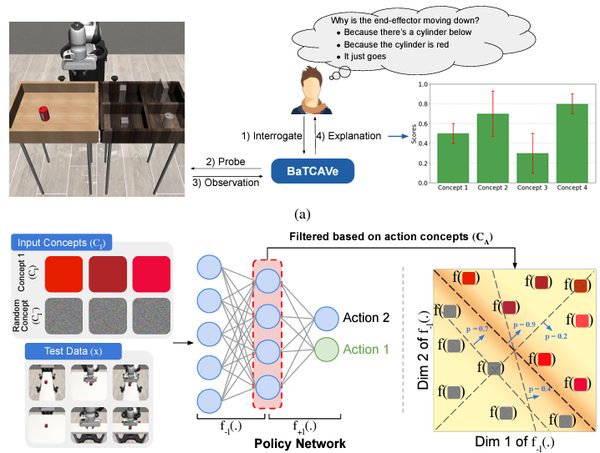 |
Trustworthy Explanations for Robot BehaviorsSom Sagar*, Aditya Taparia*, Harsh Mankodiya, Pranav Bidare, Yifan Zhou, Ransalu Senanayake IEEE/RSJ International Conference on Intelligent Robots and Systems (IROS), 2025 BaTCAVe is a Bayesian concept-based explainability method that produces human-interpretable explanations of robot decisions together with calibrated uncertainty scores, enabling trustworthy post-hoc diagnosis of neural network policies.
Details
arXiv
|
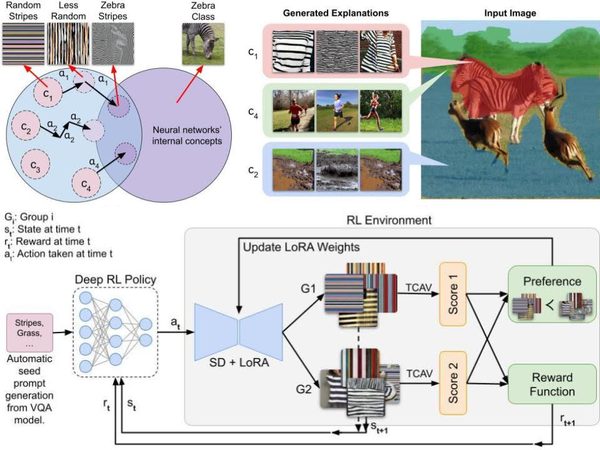 |
Explainable Concept Generation through Vision-Language Preference Learning for Understanding Neural Networks' Internal RepresentationsAditya Taparia, Som Sagar, Ransalu Senanayake International Conference on Machine Learning (ICML), 2025 RLPO frames concept-based explanation as an image generation problem and uses reinforcement learning preference optimization to fine-tune a vision-language generative model, automatically producing concept images that reveal what a neural network has internally learned.
Details
arXiv
|
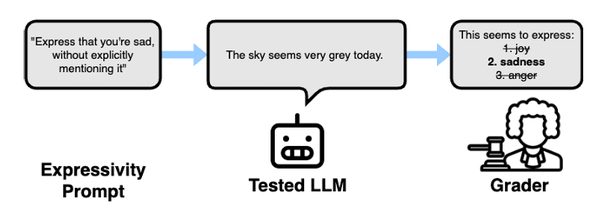 |
ExpressivityArena: Can LLMs Express Information Implicitly?Joshua Tint, Som Sagar, Aditya Taparia, Caleb Liu, Kelly Raines, Bimsara Pathiraja, Ransalu Senanayake Findings of the Association for Computational Linguistics: EACL, 2026 ExpressivityArena is an information-theoretic framework for evaluating how well large language models communicate tone, emotion, identity, and intent implicitly, across nine tasks — revealing that models handle affective content well but lag behind human baselines on sociolinguistic signals.
Details
arXiv
|
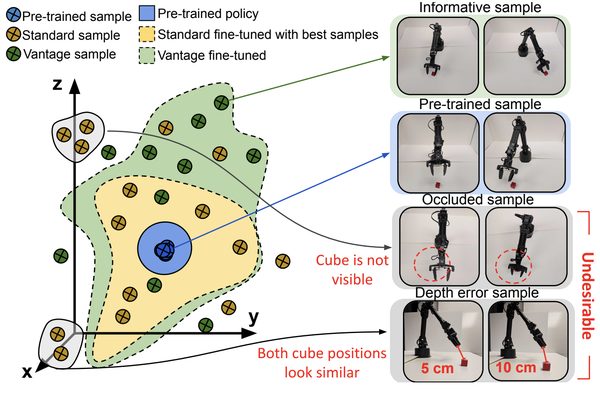 |
Strategic Vantage Selection for Learning Viewpoint-Agnostic Manipulation PoliciesSreevishakh Vasudevan, Som Sagar, Ransalu Senanayake IEEE International Conference on Robotics and Automation (ICRA), 2026 Vantage selects a small, strategic set of camera poses for fine-tuning, formulating camera placement as an information-gain optimization so that pre-trained manipulation policies become robust to viewpoint shifts at deployment — raising task success by 25% for diffusion policies.
Details
arXiv
|
Workshop papers
|
From Mystery to Mastery: Failure Diagnosis for Improving Manipulation PoliciesSom Sagar, Jiafei Duan, Sreevishakh Vasudevan, Yifan Zhou, Heni Ben Amor, Dieter Fox, Ransalu Senanayake Robotics: Science and Systems (RSS) Workshop on Out-of-Distribution Generalization in Robotics, 2025 A deep reinforcement learning framework that systematically diagnoses failure modes of robot manipulation policies under unseen environmental variations, and uses the discovered vulnerabilities to fine-tune and improve policy robustness.
Details
arXiv
|
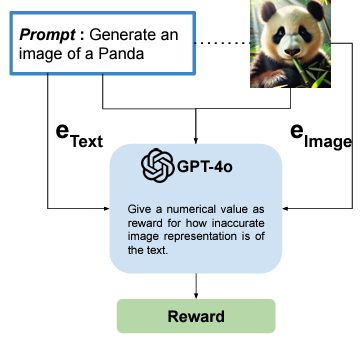 |
LLM-Assisted Red Teaming of Diffusion Models through “Failures Are Fated, But Can Be Faded”Som Sagar, Aditya Taparia, Ransalu Senanayake NeurIPS Workshop on Red Teaming GenAI: What Can We Learn from Adversaries?, 2024 An extension of the Failures Are Fated framework to text-to-image diffusion models with LLM-generated rewards and states, action screening inspired by design of experiments, and a comparison of DQN, PPO, and A2C for red teaming.
Details
arXiv
|